
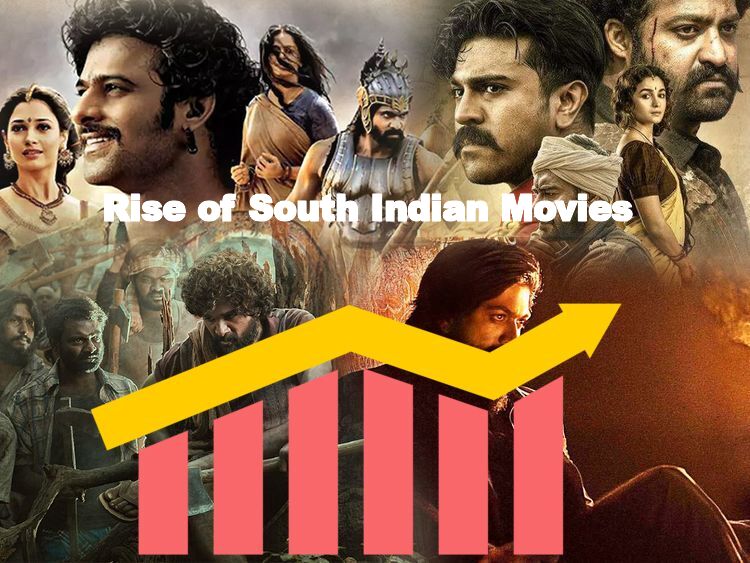
It is clear that the Hindi movie industry with its massive producers, superstars, and marketing expertise, is emerging to be a weak competition to films that are that are emerging from South India. Our fortnightly cover story examines the rise of film made in South India which has changed the most fundamental, and widely commonly accepted principles of successful Indian filmmaking.
If the entire audience at an elite Mumbai multi-plex rises up and cheers and whistles during an action scene that is climactic in an English-language Telugu blockbuster, it’s a sign that something fundamentally different is happening. This S.S. Rajamouli directorial, RRR which is the film that is in question here is among the slew of films made in the south of India which have taken the box-office to the forefront, transforming fundamental tenets of successful Indian filmmaking. It is clear that the Hindi film industry is awash with megastars, marquee production companies, and marketing skills has proven to be an ineffective rival to the south’s dominant force. Consider this report: A CII South Media & Entertainment report claims that about 62 percent of total box office revenue of all Indian films in 2021 were the south of Indian films. The trend is becoming more pronounced. According to the estimates, KGF: Chapter 2 is the Kannada action film, earned the sum of Rs 435 crore when it was released in its Hindi-dubbed version. the Dubbed versions of RRR and Pushpa The Rise Part-1 earned two crores and 106 crore and Rs 106 crore, respectively. Bollywood is a genre that has been attracting multiplex audiences in the last few years, has seen audiences who are single screens — which make up the majority of Indian moviegoers–throwing themselves into theaters across the nation to see this southern Indian action movies.
The Business of Entertainment special issue the front cover story written from Vidya S. and Prerna Lidhoo explores what is the financial implications of south Indian filmmaking tsunami which is poised to flip the traditional movie math around. South Indian producers are engaging extremely smart marketing minds and even conducting pre-production studies of tastes in the audience to learn the kind of movies that people are interested in when their preferences for entertainment change drastically after the pandemic.
But this problem is many, many more aspects than films. We analyze the OTT growth and the boost that streaming platforms have received because of the lockdown. Sohini Mitter analyzes the way that the streaming of sports will be a battleground for platforms like Disney+ Hotstar, which recently ended its rights for the Indian Premier League cricket tournament and Mukesh Ambani’s Viacom18 that won the rights to India by committing to pay the sum of Rs 23,758 crore over five years. The author also tells the intriguing story of the growth of casual gaming as the 450 million casual gamers are a huge 15,000-crore market. We provide all of this and more in this extensive collection of stories.
The issue also includes an in-depth look by Arnab Dutta on the way Swiss food giant Nestle’s Indian subsidiary, led by Suresh Narayanan, is mapping out its 2.0 version, and an elaborate plan for expansion into the highly competitive and discerning rural market. Apart from that, Binu Paul examines the difficulties faced by BYJU’S the most coveted company in the field of education technology struggling with its bleeding subsidiaries as well as the financing winter. The way that renowned businessman Byju Raveendran manages to navigate this difficult time will be fascinating to follow.

I'm a Digital Marketer, Market Researcher, and Content Writer, Who Loves to Help Others Understand the World of Marketing.